Getting lost is frustrating. Or so it has been for me. In the early pages of her book, A Field Guide to Getting Lost, Rebecca Solnit asks this question:
“Love, wisdom, grace, inspiration — how do you go about finding these things that are in some ways about extending the boundaries of the self into unknown territory, about becoming someone else?”
Solnit reminds us about the nature of explorers, trappers, pioneers all who, by their very nature spent time in unknown places.
“Never to get lost is not to live, not to know how to get lost brings you to destruction, and somewhere in the terra incognita in between lies a life of discovery.”
Solnit’s beckoned me to try getting lost. Every page held a tempting tidbit that lured me closer to the challenge. She describes Virginia Woolf’s desire to “shake off the shackles that remind you who you are, who others think you are.” She describes Cabeza de Vaca’s walking across the Southwest, shedding clothes, being severely sunburned and shedding layers of skin over and over as he became something new: A wise man who knew the plants and animals of this world he wandered.
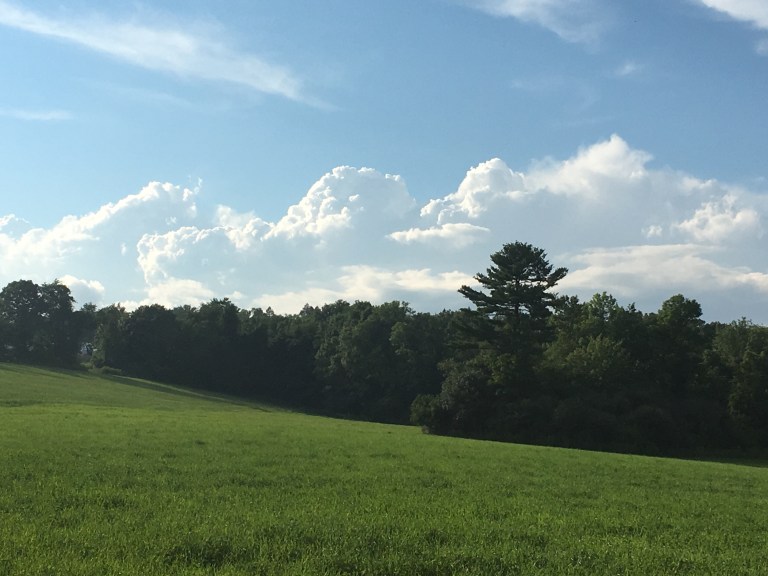 I learned that in the 15th Century, European artists began to use blue to suggest distance. Could this be the genesis of the expression “into (or out of) the blue?”
Maps, trails, G.P.S. and countless other tools to know where we are at all times, make it hard to get lost. Was I missing out on something? If I use a map or G.P.S., do I take notice of what is around me? Do I ever “expand the boundaries of the self into unknown territory?”
I decided to “get lost” in an unexplored-for-me and a low usage part of a State Park nearby. My husband and two dogs joined me as we started on a trail, wondering if we could get lost. Soon there was no more trails and we were on the marshy edge of a lake. We could turn around and head back the way we came. But we decided to, as my husband says, “bushwhack.”
By the time we got back to the original trail, the sun was sharing the last of its light, our feet were soaked, the dogs had cattail fluff and leaves and sticks in their fur and we had discovered a few things.
- Probably best to not start out getting lost in the woods within an hour of sunset where the horizon and stars are not easily seen
- Pay closer attention to those places where the forest shifts from hardwoods to evergreens; from rocky to marshy; from low on the lake to high on the hill
- We’ll do it again. Our senses were sharpened and our hearts beat a little wildly.
Did I discover a new identity for myself? What about discovering love, wisdom, grace and inspiration? Maybe with practice getting lost, I’ll know better. As Rebecca Solnit says:
“Mystery … it can be a kind of compass.”
Post Title Photo Suzanne d’Corsey


Well done! I was engaged with this post (and your emerging voice within it) all the way through to the dazzling last line.
It reminded me of how Tim likes to “get lost in Northfield.” (Really!) And how I love to take different routes to places I think I know how to approach. Sometimes this can get me into minor trouble but it is always interesting.
Today I shall be alert to what makes my own heart beat faster. (Likely sitting on the couch lost in Jennifer Egan’s startlingly imaginative novel, THE KEEP.
Looking forward to your next post! Leslie
LikeLike
Very cool, Leslie. I love the idea of getting lost in a familiar place. Food for thought. And you know I’ve gotten lost in books! One of the best things out there. Thanks for giving some thought to all this! Beth
LikeLike
I like your point about technology (GPS). With technology, we’re never really disconnected — especially from EVERYTHING “out there” that wants to define and shape who we are. No wonder so many people feel anxious when they are without their phones (mini computers). Most of us can’t even puzzle through a question or problem without googling it to find the “answer.” What a loss that is. Being physically lost, especially in the wilderness, must bring us closer to our own mortality, making us feel, ironically, more alive. At the very least, working through difficulties, problems, unknowns (the times we are “lost”) I would think must bring us closer to understanding our own identity.
LikeLike
Betty, You ran with my thoughts exactly. I know you’ve been in “lost” situations where all your senses are charged and the pulse of life runs a little stronger. I recommend Rebecca Solnit’s book. There is so much in it. It, for me, was like a box of the finest chocolates. I read one section and savored it. Didn’t love all the sections just like I really don’t like chocolate covered cherries. But it all got my brain going. May reread it.
With some of these comments in mind.
LikeLike
Beth, this has made me think.
When I lived in NC, I would connect with this feeling of ¨getting lost¨, and allow my mind to be nurtured by nature, in Pilot Mountain. Those were days of connecting with my internal paths of what it meant to leave Venezuela behind, and explore the idea of becoming a US resident: a new start, saying goodbye to what had not crystallized, paying attention to emerging dreams.
These days, no mountains in sight, I experience this need to get lost when I leave town, driving, watching in the rearview mirror the buildings, parks, roads and corners, structures I know daily, gradually fading away. Leaving it all behind opens up a space in my psyche and soul to become ever more present to every breath, every new stretch of road, every car and driver near me… at times, I veer off the planned trip and take the unknown exit, for a while, in defiance of my internal structures and, in those moments, a glimpse of grace emerges… looking at a different me which, I slowly find out, I happen to know very well but. most of the time, forget
LikeLike